

20. janvāris, 2026.
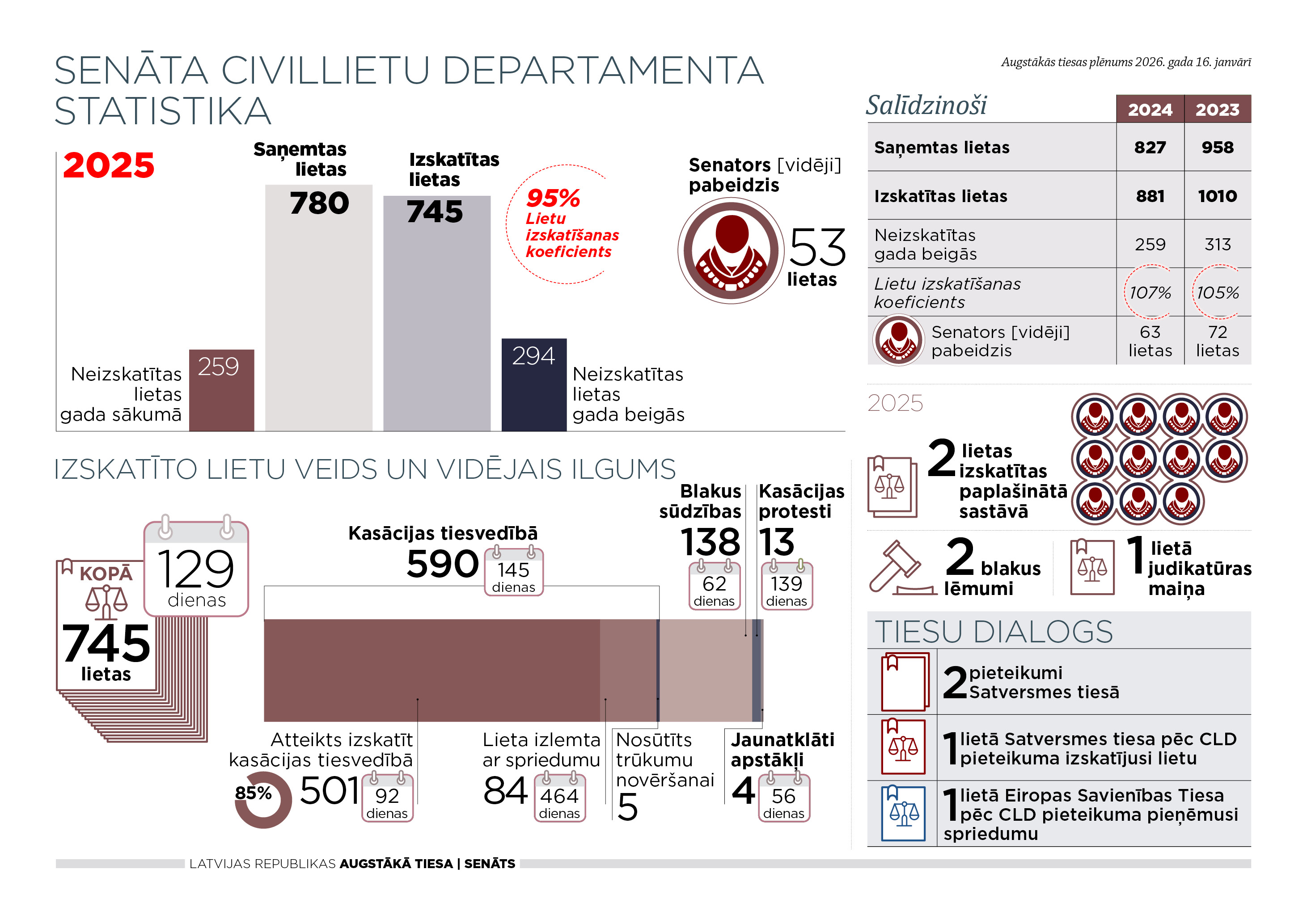
At the Supreme Court's Annual Plenary Session, as he was reporting on the work of the Senate's Department of Civil Cases in 2025, Normunds Salenieks, Chair of the Department, noted that the Department had worked in a changing composition of senators, while maintaining the goal of ensuring that cases were examined within reasonable time limits and that the Supreme Court’s case-law was consistent. The emphasis has been on developing stable, well-founded case-law.
In 2025, the Department received 780 cases and examined 745 cases. The backlog of unexamined cases increased slightly, from 259 cases at the beginning of the year to 294 cases at the end of the year. However, the backlog is not a long-term occurrence – currently, the Department is reviewing only one case received in 2022, and proceedings in that case were suspended for almost two years in connection with a request for a preliminary ruling from the Court of Justice of the European Union. 80% of the pending cases are cases received in 2025.
The work of the Department was affected by a relatively large number of cases examined by an extended judicial panel. There were nine such cases, of which two have already been decided, while the examination of the remaining cases is ongoing. The main challenge in these cases is the resolution of significant or even fundamental legal issues, which requires both in-depth research and in-depth discussion by the judicial panel.
The average time taken to examine cases has decreased slightly, from 4.5 months in 2024 to 4.3 months in 2025. The priority is adopting decisions on whether to refuse to initiate cassation proceedings – the timeframe for adopting such decisions has also lowered slightly from an average of 3.2 months to 3 months.
A stable indicator of the Department's efficiency is the outcome of cassation proceedings. In only six cases in which cassation proceedings were initiated the contested judgment was left unchanged. Normunds Salenieks pointed out that this attests to the effectiveness of the Department's approach, which means focusing on examination of a case and legal issues involved before senators decide whether to initiate cassation proceedings. All rulings by which judgments of regional courts were left unchanged are included in the Senate's archive of case-law decisions. This means that in all cases, cassation proceedings were initiated because a case was important for the development of uniform judicial practice or the further development of the law. This approach effectively ensures that cassation proceedings are initiated in a targeted manner – where the Senate's decision provides added value in ensuring uniform judicial practice.
Effective and mutually beneficial dialogue between courts is essential for the development of uniform judicial practice and case-law. The Chair of the Department of Civil Cases provided more detailed information on the dialogue maintained with the courts of first and second instance, through which the Senate obtains valuable feedback from judges who hear cases on the merits. The Chair also reported on two cases in which the Department had submitted applications to the Constitutional Court and on the responses given by the Court of Justice of the European Union to questions posed by the Department in 2023 on important aspects of consumer rights protection. The Chair considered the European Court of Human Rights' decision in the case of Finbergs v. Latvia to be important feedback on the practice of the Department, in which the ECtHR recognized that the grounds for the refusal of the Department's panel of senators to initiate cassation proceedings, with reference to the relevant provisions of the Civil Procedure Law, could not be considered arbitrary or manifestly unfounded.
Normunds Salenieks also drew attention to the Department’s participation in legislative working groups, expressing satisfaction that the Department's considerations had been taken into account in the amendments to the Civil Procedure Law on the enforcement of obligations according to warning procedures. The Department has also submitted proposals for the upcoming regulations on strategic litigation against public participation. This year, it is planned to complete work on two initiatives aimed at improving the efficiency of litigation in terms of the quality of rulings in civil cases, namely, the inclusion of the amicus curiae institution in the Civil Procedure Law and the improvement of the simplified procedure for examining cases.
At the conclusion of the report, Normunds Salenieks provided information on certain significant decisions of the Department of Civil Cases and legal issues on which the Department has expressed its views in 2025, such as the protection of honour and dignity, legal relations in the management of residential buildings, insurance issues, and contract law.
- Normunds Salenieks' report on the work of the Senate's Department of Civil Cases in 2025 will be published in the next issue of the Supreme Court Bulletin.
Information prepared by
Rasma Zvejniece, Head of the Division of Communication of the Supreme Court
E-mail: rasma.zvejniece@at.gov.lv, telephone: +371 67020396, +371 28652211

